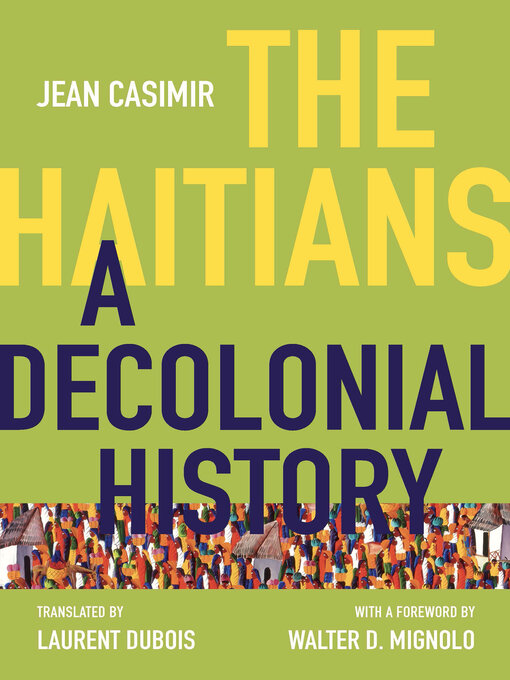
In this sweeping history, leading Haitian intellectual Jean Casimir argues that the story of Haiti should not begin with the usual image of Saint-Domingue as the richest colony of the eighteenth century. Rather, it begins with a reconstruction of how individuals from Africa, in the midst of the golden age of imperialism, created a sovereign society based on political imagination and a radical rejection of the colonial order, persisting even through the U.S. occupation in 1915.
The Haitians also critically retheorizes the very nature of slavery, colonialism, and sovereignty. Here, Casimir centers the perspectives of Haiti’s moun andeyo—the largely African-descended rural peasantry. Asking how these systematically marginalized and silenced people survived in the face of almost complete political disenfranchisement, Casimir identifies what he calls a counter-plantation system. Derived from Caribbean political and cultural practices, the counter-plantation encompassed consistent reliance on small-scale landholding. Casimir shows how lakou, small plots of land often inhabited by generations of the same family, were and continue to be sites of resistance even in the face of structural disadvantages originating in colonial times, some of which continue to be maintained by the Haitian government with support from outside powers.
- Available now
- New teen additions
- Nobel Prize
- Try something different
- Pulitzer Prize Winners
- Page to Screen
- 'Read with Jenna' Book Club
- "Hello Sunshine" Reese Witherspoon's Book Club
- Fiction with a History
- Fiction with a Supernatural Flair
- True Crime
- Banned in America
- Oprah Book Club Picks
- See all ebooks collections
- Available now
- New Audiobook Titles
- New kids additions
- New teen additions
- Try something different
- Pulitzer Prize Winners
- Page to Screen
- 'Read with Jenna' Book Club
- Nobel Prize
- "Hello Sunshine" Reese Witherspoon's Book Club
- Banned in America
- Oprah Book Club Picks
- National Book Awards Longlist 2023
- See all audiobooks collections